

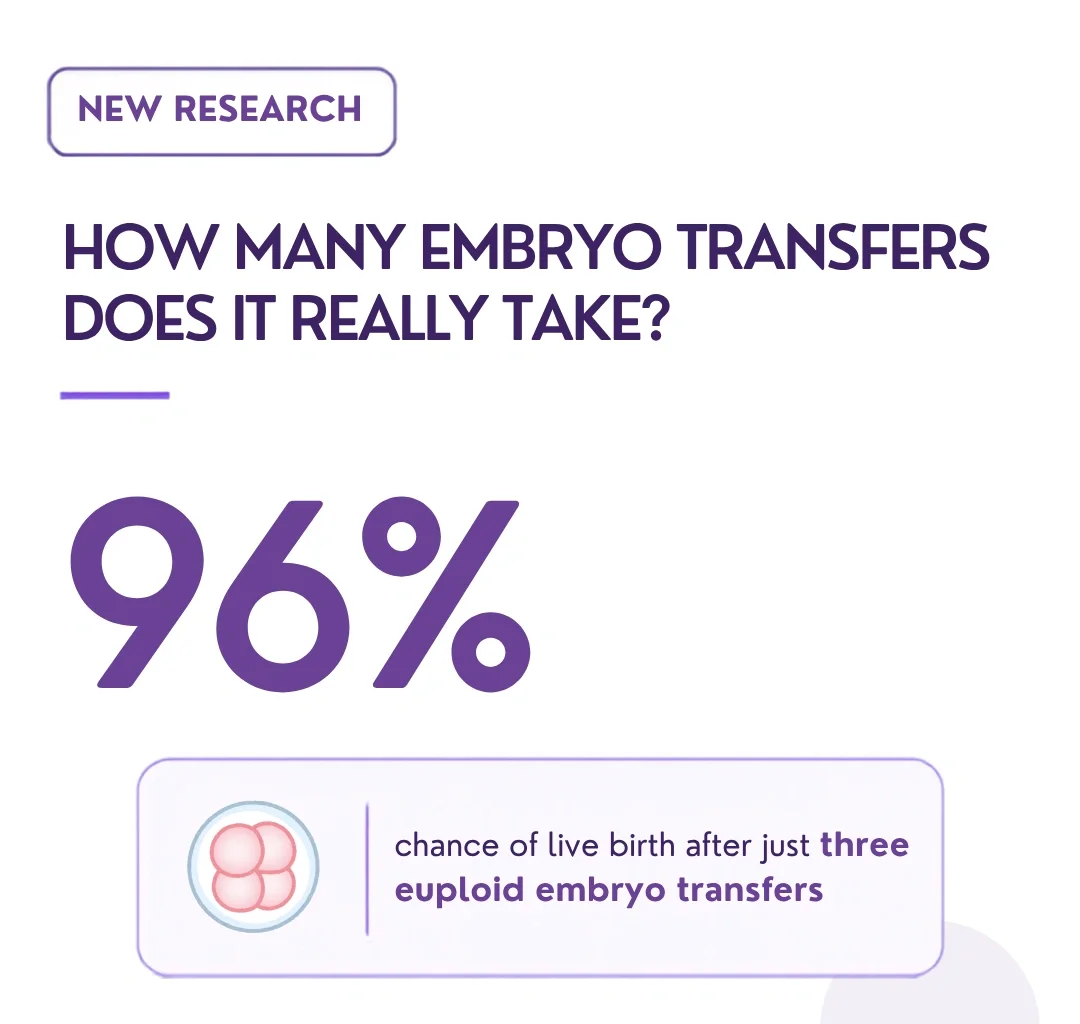
How Many Embryo Transfers Does It Really Take? New Research Offers Answers
One of the most common questions we hear from patients undergoing in vitro fertilization (IVF) with preimplantation genetic testing for aneuploidy (PGT-A) is deceptively simple: How many euploid embryos will I need to have a baby?
It's a question that carries a lot of weight. Behind it are the hopes, the setbacks, and the very real emotional and financial investment that comes with every cycle. A new study from our team at NYU Langone Fertility Center, published in Fertility and Sterility, offers some of the clearest data yet to help answer it.
About the Study
Our research team reviewed outcomes for 5,811 patients who underwent a total of 7,763 single embryo transfers using chromosomally normal ("euploid") embryos between 2014 and 2024. Each patient was followed through up to six sequential transfers, either until they achieved a live birth or discontinued treatment.
The goal was to answer two connected questions: How does the cumulative chance of having at least one live birth change with each additional transfer? And does the chance of success on any single transfer decline the more attempts a patient has had?
What the Study Found
The cumulative probability of achieving at least one live birth rose substantially with each transfer:
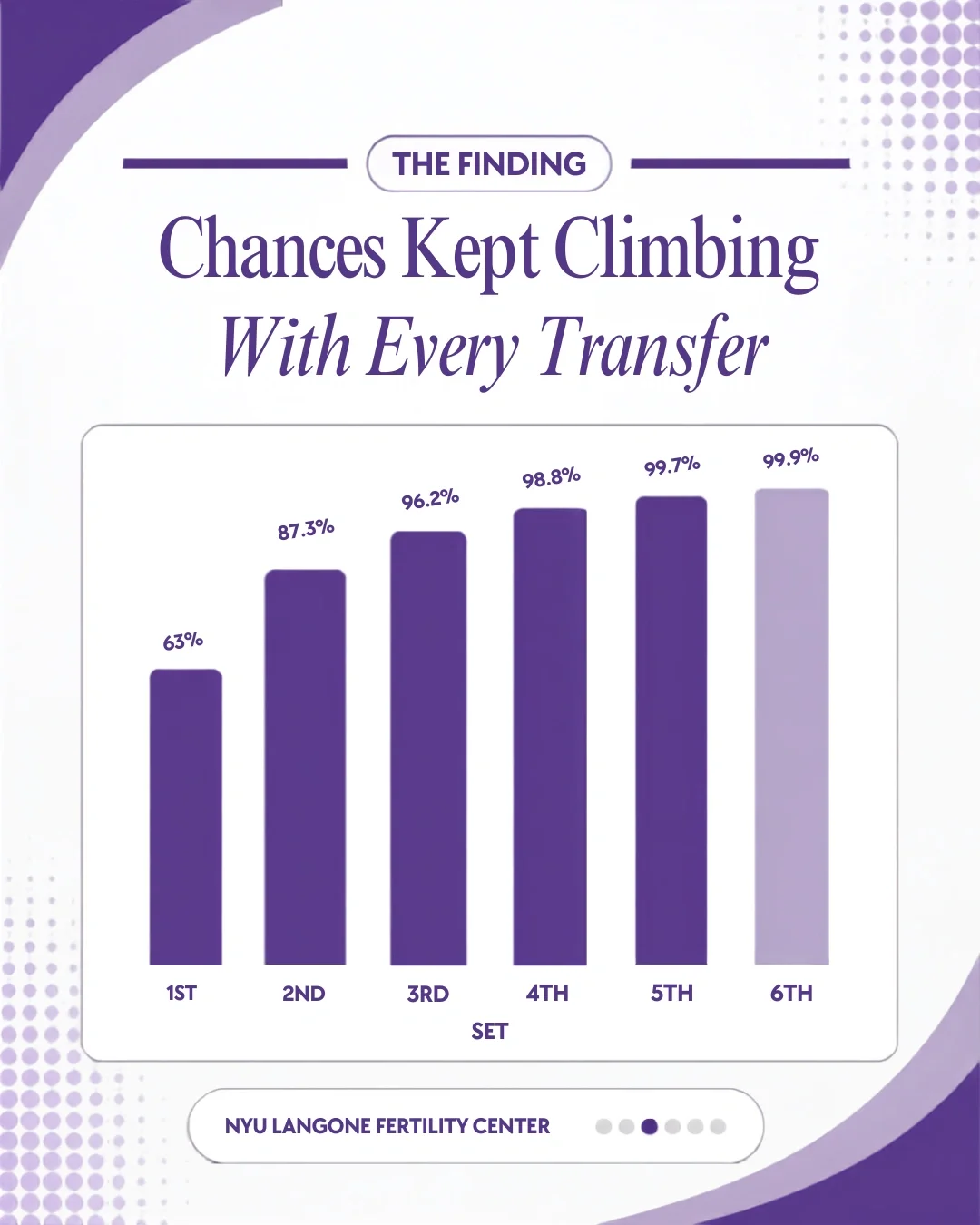
Just as notable was what stayed stable. After an initial decline between the first and second transfer, the per-transfer live birth rate held steady across the second through sixth attempts. In other words, a transfer that doesn't result in a pregnancy does not appear to lower the odds of the next one working. Each additional euploid embryo carried a similar chance of success on its own.
The study also looked at "recurrent implantation failure" (RIF) — a term used when a patient does not achieve a live birth after several transfers. Fewer than 5% of patients in this study met that definition even after three consecutive transfers, and fewer than 2% remained without a live birth after five. These findings echo prior research from other centers and reinforce a growing consensus in the field: true, unexplained recurrent implantation failure is uncommon among patients with an adequate supply of euploid embryos.
Rates of early pregnancy loss, biochemical pregnancy, and non-pregnancy outcomes followed a similar pattern — rising slightly between the first and second transfer, then remaining consistent through later attempts. This means that when a pregnancy is achieved on a later transfer, the risk of early loss does not appear to increase compared with earlier attempts.
What This Means for Patients
For patients who have experienced one or more unsuccessful transfers, we know how discouraging that can feel. This research offers a reassuring, evidence-based perspective: an unsuccessful transfer is not a predictor of future failure. For most patients with an adequate number of euploid embryos, continuing with sequential transfers is associated with a high likelihood of eventually achieving a live birth.
This doesn't mean the path is the same for everyone. Age, ovarian reserve, and the number of euploid embryos a patient is able to generate all shape what "sufficient" looks like on an individual level — and every patient's tolerance for continued treatment, physically, emotionally, and financially, is different. What this data provides is a clearer picture to help guide those conversations, so patients and their care teams can make informed decisions together about how many embryos may be needed to reach a desired level of confidence.
It's also worth noting what the study did not find a need for: the progressive rise in success rates occurred without routine use of additional interventions such as endometrial receptivity testing or empiric adjunct treatments — consistent with our center's evidence-based approach to care after a failed transfer.
The Bottom Line
Chromosomal status is an important factor in embryo selection, but it is not the only one — and no single transfer defines the outcome of a treatment journey. For patients able to generate a sufficient euploid embryo inventory, this research supports what we tell patients every day: persistence, paired with personalized care, is associated with a strong likelihood of success.
This study, "Cumulative probability of a live birth after up to six sequential single euploid embryo transfers," was authored by Claudia Durbin, MS | Carlos Parra, MD | Jennifer Blakemore, MD | Shannon DeVore, MD | Brooke Wertz, MD, MPH | Elizabeth Fino, MD | Fredrick Licciardi, MD | Alan Berkeley, MD | Caroline McCaffrey, PhD, HCLD | James Grifo MD, PhD
Categories
The NYU Langone Fertility Center Blog
At NYU Langone Fertility Center, our first job is to support our patients as they become educated about their reproductive health and fertility treatment options. Our blog connects patients with the most up-to-date information, technologies, and insights into fertility care. From egg freezing to IVF to third-party reproduction options, we explore every facet of assisted reproductive technology and empower patients with the knowledge they need to navigate their family building journeys.